Zillow · Content Design practice · 2027 charter
Content Design Charter: priorities, ownership and team direction
Co-led the strategic direction and engagement model for the 13-person Content Design practice.
- My role
- Co-led practice direction and shaped the 2027 charter with domain leaders
- Worked with
- A co-lead Senior Manager, domain leaders and Design leadership
- Scope
- Four priorities, six measurable targets, five engagement levels
- Status
- Working proposal. Operating plan moving to launch
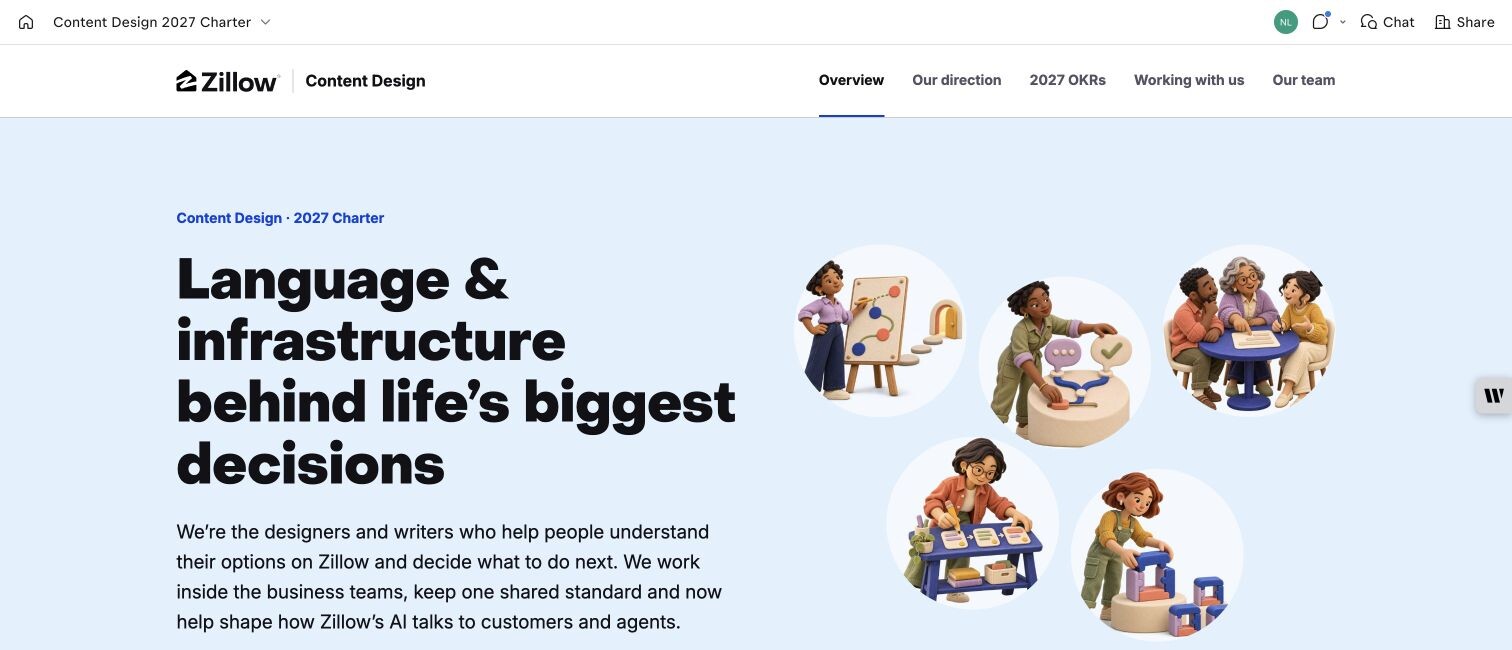
People in the practice, serving multiple business lines.
Priorities for 2027, from AI craft to extending quality through tools.
Levels of engagement, from owning strategy to self-service.
Measurable targets, each with an owner, baseline and pilot.
The problem
One shared quality bar across several business lines, without taking day-to-day decisions away from the teams closest to the work. AI adds a second test: product language and model behavior have to make the same promise.
What I did
I co-led the 2027 charter with domain leaders. It turns a broad mandate into four priorities, clearer ownership, and an engagement model that separates work needing deep partnership from work tools can support.
What happened
The priorities became six targets with owners, baselines and pilots. The team now has a shared basis for deciding where time goes and what it says no to.
The problem
One quality bar, without a central bottleneck
The practice serves multiple business lines. Every request is reasonable, and the team cannot staff all of them at the same depth.
A shared standard, local decisions
The practice needed one quality bar, and product teams needed to keep making day-to-day decisions themselves. The charter had to give partners guidance for routine calls.
Product language and model behavior
When an AI experience speaks, the words and the model behavior are one promise. The practice needed a clear position on who defines quality there.
The constraint I made explicit
Capacity is part of the commitment. New work fits the time available, or we say what gives. Evaluation, enablement and coaching need time alongside delivery.
My role
Direction first, then the people who do the detail
I co-lead the practice with another Senior Manager. The charter is a working document, shaped with domain leaders rather than handed down.
What I co-led
Practice direction. I shaped the 2027 charter with domain leaders, turning the mandate into four priorities, clearer ownership and an engagement model.
How I matched people to work
Five archetypes guide how I place and grow people: product content designer, experience strategist, AI experience and behavior designer, quality systems builder, and practice leader.
What I carry into launch
Confirming owners, capacity, baselines and pilot initiatives, then using partner reviews to adjust the model as teams apply it.
The engagement model
Match involvement to risk and opportunity
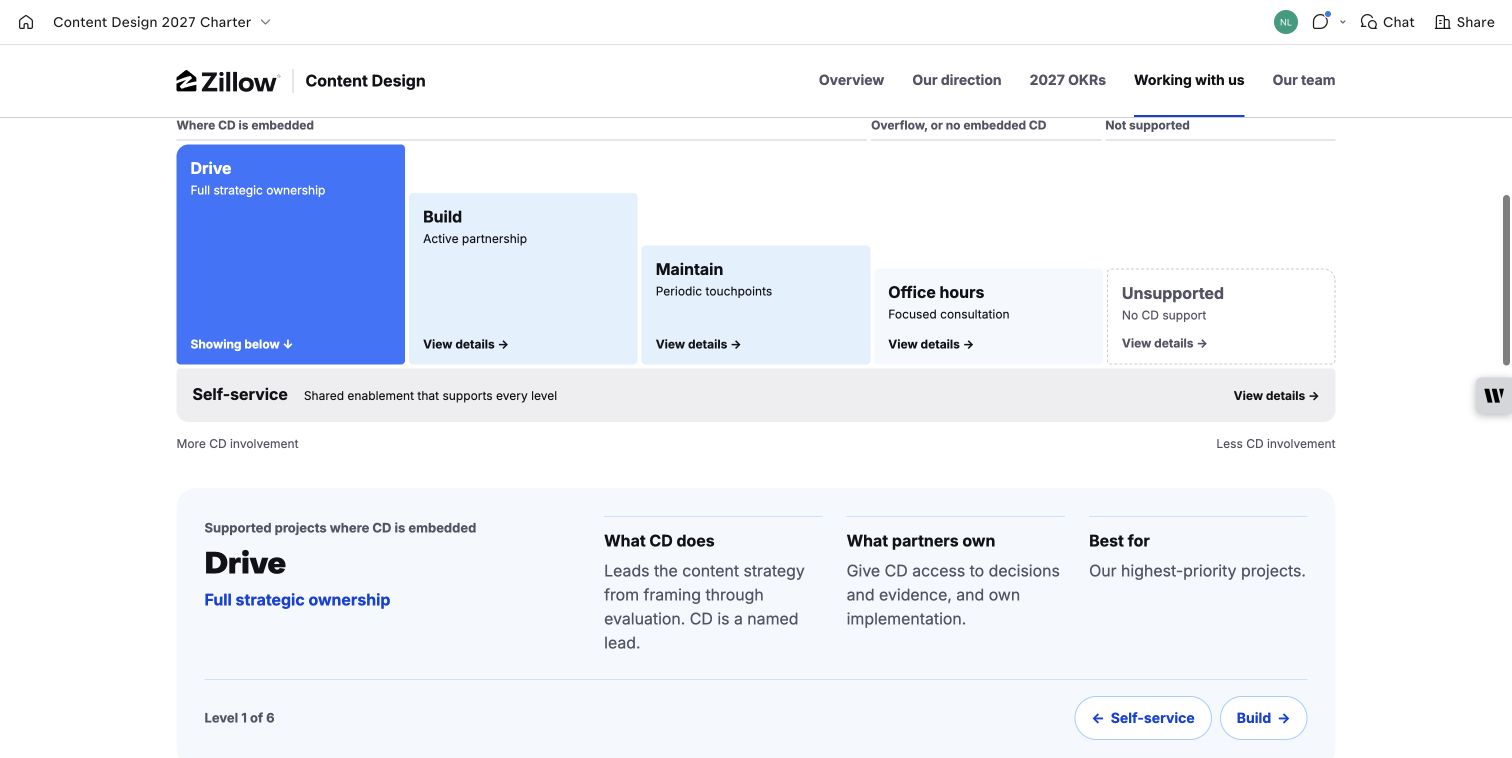
Not every project needs the same kind of partnership. Five levels give partners and designers a shared way to agree who owns the work before it starts.
- Full strategic ownershipDrive
Content Design leads content strategy from framing through evaluation. Partners provide decision access, evidence and implementation ownership.
Embedded businesses - Active partnershipBuild
Ownership is shared through design and iteration. Partners agree who leads, who implements and who evaluates.
Embedded businesses - Periodic touchpointsMaintain
Content Design reviews stable experiences at agreed milestones. Partners flag changes in scope, behavior or risk.
Embedded businesses - Focused consultationOffice hours
Partners bring a bounded question. We help clarify the decision or next step, and the requesting team owns follow-through.
Overflow work - Shared enablementSelf-service
Documented guidance, terminology, supported skills and examples for repeatable decisions. It supports every level above.
Overflow work
How a team lands on a level
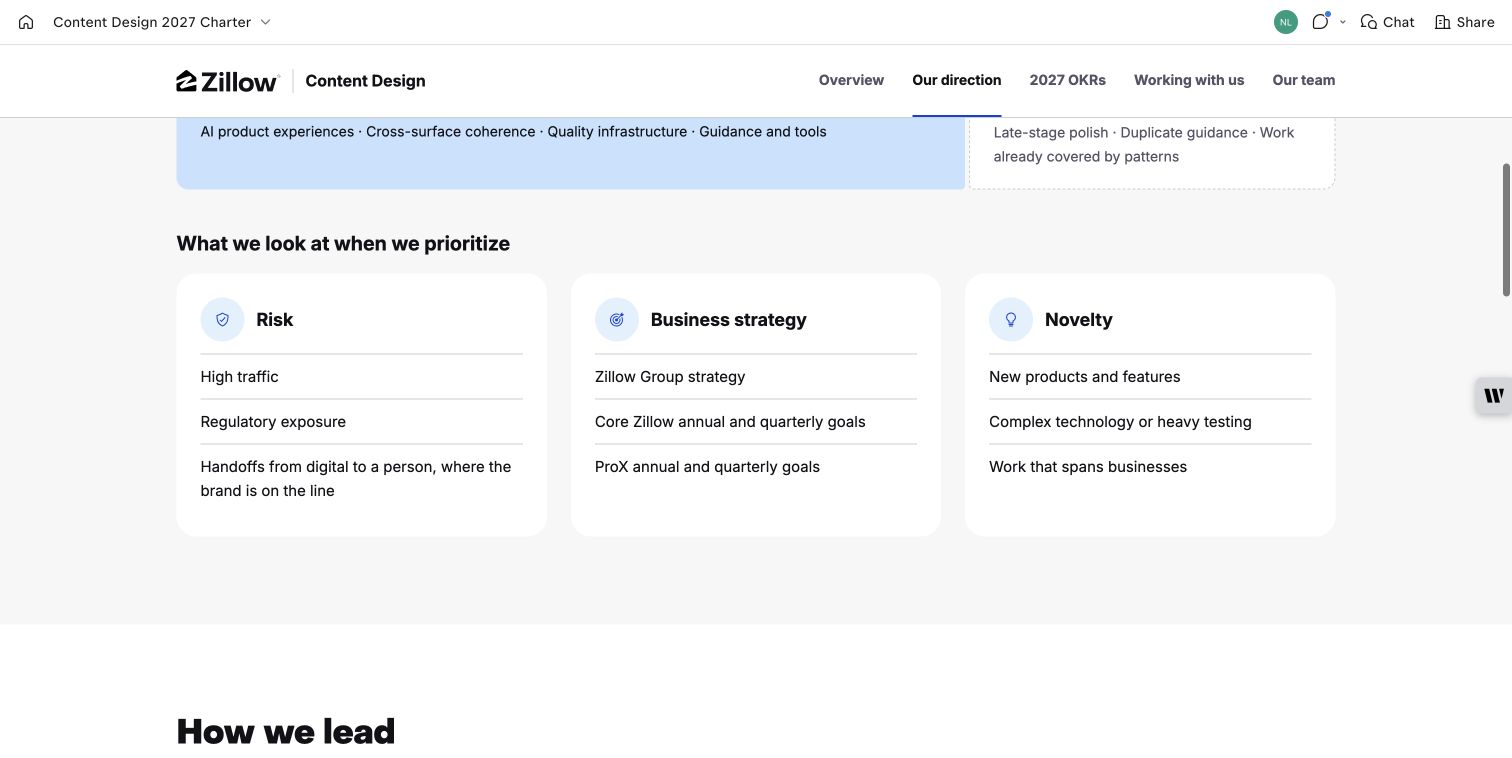
Prioritization looks at customer risk, business strategy and novelty. At kickoff or a material scope change, we agree contributions, decision owners and checkpoints.
Priorities and targets
Four priorities, six numbers to hold us to
A direction only counts if the team can tell whether it is working. Each priority is paired with a measure, an owner and a date.
Raise the craft bar
Improve AI-generated and AI-adjacent content.
Strengthen strategic positioning
Increase Content Design's visibility and influence in product strategy.
Grow a high-craft culture
Build an intentional culture that supports strong, consistent craft.
Extend our quality
Build guidance and tools that help more teams apply our standards.
The 2027 scoreboard
When each target comes due.
| Due | Target | What we will show |
|---|---|---|
| Q2 | AI quality | Test three pilots. |
| Q2 | Strategic influence | Content Design involved early in 80% of priority initiatives. |
| Q3 | Shared quality bar | 80% reviewer agreement on actionable ratings across two review sessions. |
| Q3 | Partner enablement | 80% of participants across three workflow pilots complete tasks to standard without direct help. |
| Q4 | AI quality | Material experience failures down 25% against baseline. |
| Q4 | Strategic influence | Influence shown on at least three decisions. |
| Q4 | Decision speed | Median time to an accepted content decision down 20%, with no rise in defects or rework. |
| Ongoing | Risk routing | 90% correct routing with no missed critical-risk cases. |
Source: Content Design 2027 charter and operating plan. AI quality and strategic influence each carry two milestones, so the eight rows add up to six targets.
Tradeoffs
What the charter chooses, and what it gives up
A charter is mostly a list of things the team agrees to do less of.
Fewer projects, done at depth
BuysTime for the hardest problems, where content strategy changes the outcome.
CostsSome requests get office hours or self-service instead of an embedded partner.
Enablement as a maintained system
BuysGuidance and tools that raise quality in rooms we are not in.
CostsNamed owners, capacity, feedback and upkeep. It is not a one-time content library.
A shared bar, local decisions
BuysPartners keep routine calls and move faster with guidance.
CostsLess central control over every decision.
What comes next
From a plan on paper to a practice that runs on it
The charter has to change real decisions to count.
Confirm the operating plan
Owners, capacity, baselines and pilot initiatives, agreed with domain leaders.
Use partner reviews
Partner feedback decides where the engagement model needs to change as teams apply it.
Watch for real change
How the charter shifts staffing, sequencing and engagement decisions, then progress on AI quality, earlier involvement and partner independence.